The Salvation Army, an international movement, is an evangelical part of the universal Christian Church. Its message is based on the Bible. Its ministry is motivated by the love of God. Its mission is to preach the gospel of Jesus Christ and to meet human needs in his name without discrimination.
ONE ARMY: We see a God-raised, Spirit-filled Army for the 21st century - convinced of our calling, moving forward together
We will...
ONE MISSION: Into the world of the hurting, broken, lonely, dispossessed and lost, reaching them in love by all means
We will...
ONE MESSAGE:With the transforming message of Jesus, bringing freedom, hope and life
We will...
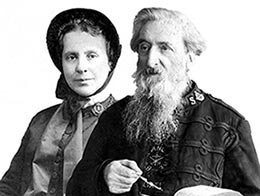
The Salvation Army began in 1865 when William Booth, a London minister, gave up the comfort of his pulpit and decided to take his message into the streets where it would reach the poor, the homeless, the hungry and the destitute. His original aim was to send converts to established churches of the day, but soon he realized that the poor did not feel comfortable or welcome in the pews of most of the churches and chapels of Victorian England. Regular churchgoers were appalled when these shabbily dressed, unwashed people came to join them in worship. Booth decided to found a church especially for them - the East London Christian Mission. The mission grew slowly, but Booth's faith in God remained undiminished.
In May 1878, Booth summoned his son, Bramwell, and his good friend George Railton to read a proof of the Christian Mission's annual report. At the top it read: THE CHRISTIAN MISSION is A VOLUNTEER ARMY. Bramwell strongly objected to this wording. He was not a volunteer: he was compelled to do God's work. So, in a flash of inspiration, Booth crossed out 'Volunteer' and wrote 'Salvation'. The Salvation Army was born.
Countries where The Salvation Army is at work
A country in which the Army serves is defined in two ways:
(i) Politically
(ii) Where the General has given approval to the work, thus officially recognizing it, ensuring it has legal identity and a Deed Poll is published to acknowledge this.
As far as political status is concerned, for the Army’s purposes, three categories are recognized:
(a) Independent countries, eg, USA and New Zealand;
(b) Internally independent political entities which are under the protection of another country in matters of defence and foreign affairs, eg, The Færoes, Isle of Man, Puerto Rico;
(c) Colonies and other dependent political units, eg, Bermuda, French Guiana, Guam, Guernsey, Jersey, Virgin Islands.
Administrative subdivisions of a country such as Wales and Scotland in the UK are not recognised as separate countries for this purpose. The countries fulfilling the quoted criteria, with the date on which the work was officially recognised in brackets, are as follows:
To Know, Countries where The Salvation Army is at work please click here
For almost as long as The Salvation Army has existed, it has operated hospitals and clinics in some of the most needy areas of the world. That remains true today. The Salvation Army’s medical services are most effective, influential and sustainable when they link to health-related community development, which gives local people – Salvationists and others – the opportunity to participate.
The international vision statement for health ministry:
The Salvation Army seeks to be a significant participant in the delivery of faith-based, integrated, quality primary health care as close to the family as possible giving priority to poor and marginalised members of society. The Salvation Army offers education programmes that equip health workers with appropriate skills and experience as well as developing commitment to holistic Christian health ministry.
The Salvation Army works in 126 countries and in every country Salvationists respond to the health concerns in their communities through more than 15,000 churches (corps). In addition to church-based programmes, The Salvation Army currently has 183 health programmes in 39 countries, focusing on healthcare and the prevention of disease. These include 23 general hospitals and more than 150 clinics and health posts. Almost all of these include response to HIV/AIDS. At a conservative estimate, between seven and eight million people are specifically involved in community development responses. These care, support and prevention programmes are characterised by local community ownership.
The Salvation Army prioritises the following
We encourage local communities to respond to health issues, to increase their capacity to care, change and develop healthy communities and to have hope and a knowledge of the grace of God in Christ.
The International Health Services – part of the Programme Resources Department at The Salvation Army’s International Headquarters – supports and encourages the development of health services throughout the world where The Salvation Army operates, and influences the development of local and international partnerships.
Copyright© 2016 Catherine Booth Hospital Nagercoil.
Website Designed and Maintained by Alleva Infotech.