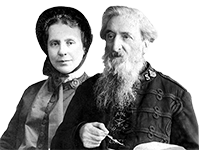
Out of profound love for people and concern for their physical and spiritual welfare Bramwell Booth, son of William Booth, the founder of Salvation Army visited certain workmens' cottages in the vicinity of Victoria Park, in the east end of London by 1870. It was also his love for people which made Bramwell's sister, Emma who took upon herself the responsibility of bringing up an orphan, Harry Andrews'. Emma along with her husband Commissioner Booth Tucker and Harry Andrews, a 15-year old boy at that time came to Bombay. At the age of 17 Harry Andrews was appointed to assist Major William Stevens in Nagercoil. When Harry Andrews came to India the nation was besieged with an outbreak of cholera, smallpox, typhoid and hundreds of thousands of people were allowed to die for want of proper medical attention, and there was no hospital available in and around Nagercoil.
Solveig Smith states, "It was love for people and concern for their physical and spiritual welfare which led young Harry Andrews to use the healing virtues which he possessed to bring relief to the suffering around him." Mrs.Stevens becoming aware of Harry Andrews sympathies for the poor suffering from diseases and his keen desire to relieve their suffering observes: 'The boy wants to heal bodies and I'm going to make it easier for him. He shall have that little bathroom at the end of the verandah for a dispensary".
The amateur dispensary in the bathroom was set up in 1893, and patients walked many miles to seek help at the hands of Harry Andrews who had a remarkable practical ability to render medical assistance to them with a limited means at his disposal.
The severe outbreak of cholera in Travancore first became the field of work for Harry Andrews. He gathered a few simple remedies, walked from village to village, ministering to the sick and dying and thus his mission of healing the sick started. News of Harry's skill was reported to the Salvation Army's London Headquarters. Bramwell Booth thought it worthwhile to bring Harry Andrews to England to take a dresser's course in a London Hospital. He returned to India in 1896 with increased confidence and boyish delight. He received the news that a friend had given £ 50 with which to purchase a piece of land where 'a proper dispensary' could be erected. He and Major Stevens chose a site and knelt down in the open country to seek divine blessing for their work.
"The dispensary, which rose on the spot, was a whitewashed mud-walled building with a grass-thatched roof that gave shade some feet outside the walls.It was named the Catherine Booth Dispensary in honour of the Army Mother, Co-founder with William Booth of the Salvation Army. As the work began to grow, a large building became necessary. Harry found a site, designed the new building and helped to dig its foundations'. This was the beginning of Salvation Armys' medical work as well as the beginning of Catherine Booth Hospital.
Dr. Percy Turner arrived in India and took up his medical appointment at the Catherine Booth Dispensary, Nagercoil, in 1990. He was the first qualified Salvation Army medical missionary doctor. This institution which was started as a dispensary was widened and developed in every section by Dr. Turner, a renowned ophthalmologist.
On 27th April 1901, the stone laying ceremony of the Catherine Booth Hospital took place and the stone was laid by the then Prime Minister of Travancore State, V.I. Kesava Pillai.
In 1901, the dispensary was elevated to become the Catherine Booth Hospital. In view of the increase in the number of patients, new wards for men and women were put up. An operation theatre and laboratory were put up and separate kitchens were built for Hindu and Muslim patients and their friends, who came to the hospital with them and stayed to cook their meals.
Harry Andrews was soon transferred to a hospital in North India. Dr. Turner's fiancee, Captain Minnie Maygar, a fully qualified nurse came to India eventually and their wedding took place in October 1902. Soon they were fully occupied together in the hospital, Percy Turner instructing. Indian compounders in the skill of dispensing and Mrs. Turner beginning the training of Indian nurses. Turner paid a visit to the Maharaja of Travancore and from whom he sought financial help for his project of four year medical course, with laboratory work and dissections within the hospital. With the help of another doctor he was able to offer courses and the students were given regular examinations according to the English syllabus.
Miriam Richards states that three men eventually qualified for the Diploma, to be recognized by the letters L.M.S.M.G. (Licentiate in Medicine, Surgery, Midwifery and Gynaecology). Among those who trained under Turner, three of the Salvation Army officers recognized as registered medical practitioners in Kerala State. Brigadier T.C. Chacko, Senior Major S. Gnaniah and Senior Major J. Manuel, rendered valuable service over many years.
During the period of Turner, medical school became an integral part of the hospital, the students learning as much by an apprenticeship in the wards as by lectures in the class room. Dr. Turner and Dr. Steibel shared both the teaching and the surgery.
In 1912, cholera broke out in epidemic form in and around Nagercoil. As a result, medical demands increased immeasurably. Hundreds were dying as the epidemic raged throughout Kanyakumari District. Turner and Steibel were faced with a dilemma. Turner held his Diploma in Public Health and weighed the matter judiciously. Finally, the two doctors worked out a plan. A breach was made in the compound wall and well away from the other wards, a pandal overlaid with coconut leaf thatches was erected. Steibel with the help of 30 medical students spent all their off-duties in the nearby villages, and saved as many lives as they could. After some months the enthusiastic Dr. Charles Steibel was appointed elsewhere.
Mrs. Steibel wrote in a personal record in 1920 which was published subsequently, "We had no surplus time for such extra duties as were involved by the cholera epidemic. Charles had to take it out of his sleep, and he did it gladly as the obvious duty of a man who was a medical missionary and not merely a doctor". In 1921, after 21 years of outstanding service Dr. Turner and his wife left India, the Colonel being appointed as the Army's Chief Medical Officer at International Headquarters, London.
Dr. William Alexander Noble who succeeded Dr. Turner reached Nagercoil in 1921. He was an American Officer who became known and loved as Bahadur. Remarkable developments had taken place in the hospital during his more than twenty years service and new branch hospitals and dispensaries had been added.
In 1921, the number of out patients who received treatment was 23,688. The in-patients numbered 1,046. 1,722 surgical operations were carried out in that year.
In 1923, Dr. Noble opened a branch dispensary at Radhapuram in Nellai Kattabomman District. Two years later, a proper building for the hospital was constructed. During his time, a Battery Room was built in 1924 and Electronic Storage Batteries were installed to use electric light and power in the hospital.
During the 1920s and 1930s, Dr. Noble paid particular attention to the treatment of cancer cases, mostly cancer affecting the mouth. The existing wards were not large enough to accommodate all the cancer cases that came to the Catherine Booth Hospital. Even the verandahs were seen with rows of grass - mats serving as 'beds'. More general surgery was done than ever during the time of his illustrious predecessor, Dr. Turner of eye treatment fame, so to say Dr. Noble specialised in eye treatment also and his success was phenomenal.
In 1931, Dr. Noble received the Keisar - I - Hind Silver medal and served as palace physician to the Maharaja of Travancore. In 1932, the old European Nurse's Quarters was pulled down and a two storied quarters was built providing accommodation for six nurses.
In 1933, the old out-patients department and office building was pulled down and replaced with a modern administrative block. This comprised the usual out patients Department, dispensary, 'medical stores, dental department, emergency ward, consulting rooms and doctor's rooms. This building was opened by Sri. C.P. Ramaswamy Aiyar, who was the then Advisor to the Maharaja of Travancore.
In 1935, Noble opened the Evangeline Booth Leper Hospital at Putherncruz with accommodation for about 160 patients.
In 1937, Dr. Noble started the nursing training with eight students. Dr. Noble was ably assisted by Catherine Lord of USA, who became the nursing superintendent. By 1948, sixty seven young people had been trained and registered as nurses and twenty had further qualified as midwives. This was a great milestone during Dr. Noble's period.
The year 1939 was made memorable by the opening of a Laboratory, Indian Nursing Home and the Isolation Block. These buildings were built out of the funds received as donation from USA.
During Dr. Noble's time many other buildings such as Obstetric Block, Madhavan Thambi Building for Women and Children and the Sankaran Thambi Block were constructed. These buildings were built with donation received from the royal family of Travancore. The Sankaran Thambi Block was built for Tuberculosis patients.
Dr. Noble was responsible for the construction of Golden Jubilee Building and it was opened in 1954. The hospital compound had been enlarged from eight mudbrick buildings in 1920 to 46 concrete granite and more substantial edifices in 1948, and by 1960 the number of buildings totalled sixty four.
From 1921 to 1960 the Catherine Booth Hospital was under the efficient administration and contribution of Dr. William Noble. Noble along with his wife served long. His period was considered as the golden period in the history of the hospital. By his selfless service, Dr. Noble raised this hospital to become one of the best hospitals in India. On 25th August 1961. he retired from service and went back to America.
After Dr. Noble's retirement Dr. Harry Williams was appointed as the Chief Medical Officer of the Catherine Booth Hospital. His previous experience stood him in good stead, and the reconstructive surgery he practised at the Catherine Booth Hospital soon developed into branches, first a Physiotherapy Department, then rehabilitation and a separate institution for vocational training for the physically handicapped. Lakhs of disabled and handicapped have been immensely benefited. During his time, a new auditorium providing much needed teaching space for the school of nursing was completed in 1966. In 1967, the Bramwell Booth Opthalmic Complex was opened by Dr. Harry Williams. Dr. Harry Williams was very shrewd and one of the outstanding plastic surgeons in the medical world. During his eight years of successful service as medical officer in this hospital there were many upheavals in introducing the latest techniques of medical service in various branches of the hospital and he retired in 1968.
After the retirement of Dr. Harry Williams, the medical work was carried on faithfully by Dr. Lyle Alloway. He came with his wife from America. Following the Alloways marriage in 1949 and graduation in 1952, came four difficult years while Lyle attended medical school in Chicago and Ruth equipped as a B.Sc., worked as a nurse to help support them both, while they meantime continued as active Salvationists. In 1957, a year after receiving his M.D. degree, Dr. Alloway, with his wife entered the USA Western Territory's School for officers' training and, when their appointment to the Catherine Booth Hospital was made 'hope became a reality' and they set off with joy for their long anticipated medical missionary work. During the time of Alloway the hospital grew and a number of buildings were constructed. He devoted his services for the uplift of the hospital and also bestowed his intellect for the betterment of the poor and the needy. This aspect of his medical career earned him a great name among the poor folk.
The field in which Lyle Alloway's talents were particularly to find outlet was that of opthalmology, long a speciality at Catherine Booth Hospital, where Dr. Turner had set a precedent which Dr. Noble had been proud to follow and extended. Later, in 1973, Alloway himself was to return to the University of Chicago for post graduate work in eye diseases, and his undoubted skill was further enhanced by study and practice. In 1972, a meeting of the Medical Committee of the Salvation Army was held in Bombay. It was decided that the heavy responsibility of administration should be taken away from the doctor and given to a non-paramedical man so that the administrator could spend all his time in administration and also the doctor could spend all his time in giving treatment.
According to this, one Hector Jacob was appointed as the administrator in 1973 and Dr. J.M. Simha was appointed as Chief Medical Officer. They took maximum efforts to improve the hospital. In 1976, Hector Jacob was transferred to Vellore and he died on 5th July 1982 at Vellore. After Hector Jacob, Major Keneth A. Tutton assumed charge as administrator. He came from Canada. During his time Dr. K.C. Joseph was appointed as the Medical Superintendent. K.C. Joseph worked hard to improve the patient care and Tutton took stringent measures to improve the financial position of the hospital. By his administration, he equipped the laboratory with new equipments in 1977. Tutton was transferred to another department in 1978 and later he was appointed as the territorial commander of the South Western Territory.
Terence K. Willey was appointed as administrator after the transfer of Tutton to Trivandrum. With his able administration he brought quick developmental changes both in medical and para-medical department. During his period many diagnostic equipments had been obtained for the hospital and a School of Radio-Diagnostic Technology was started in 1980. From 1978 to 1981 he rendered yeoman service to this hospital. Rader succeeded K. Willey as administrator in 1981. In the same year K.C. Joseph retired from service and in his place Dr. Finkbiner was appointed as Chief Medical Officer. During his period of administration new private rooms were opened for obstetric patients and a third operation theatre was also opened to accommodate the increasing load of surgical cases in obstetrics and gynecology. Terence K. Willey was a good administrator and he retired from service in 1983. James D. Hood became the next administrator after Herbert C. Rader. He came from USA. He was an intelligent and enterprising young man. Like his predecessors, he also introduced many reforms during his period of administration. In 1984, Sara Daniel was appointed to this hospital as a Licenced Medical Practitioner, with special responsibility for women and child patients. The women's and children's department made remarkable progress under her direction. In 1985, the medical mission celebrated its 90th anniversary. Thiru. S. Munir Hoda, the Collector of Kanyakumari District, Thiru. G.K. Moopanar and Thiru. M. Arunachalam, Minister of State for Industries participated in the celebrations. Many equipments had been obtained for the hospital during James D. Hood's period of administration and in 1990 he left for USA
Lieutenant Colonel P. Selvaraj was the first Tamil Salvation Army Officer to become the administrator of Catherine Booth Hospital. He is noted for his kindness and for his sympathetic approach to the problems of the poor patients, hospital workers and other staff. Immediately after assuming charge as administrator he began to examine the demands connected with hospital workers and staff and took sincere efforts to settle their demands. He found solutions for some of their problems and brought about amicable settlement. Dr. Ian D. Campbell, Medical Advisor from International Headquarters paid a visit to the Catherine Booth Hospital in November 1990. The Medical Record Technology Course was started by the medical record department in 1990 and later it was discontinued as it was not successful. Due to the initiative taken by the administrators many new buildings were constructed, the Psychiatric and isolation wards were opened in 1991.
Click here to read More...Copyright© 2016 Catherine Booth Hospital Nagercoil.
Website Designed and Maintained by Alleva Infotech.